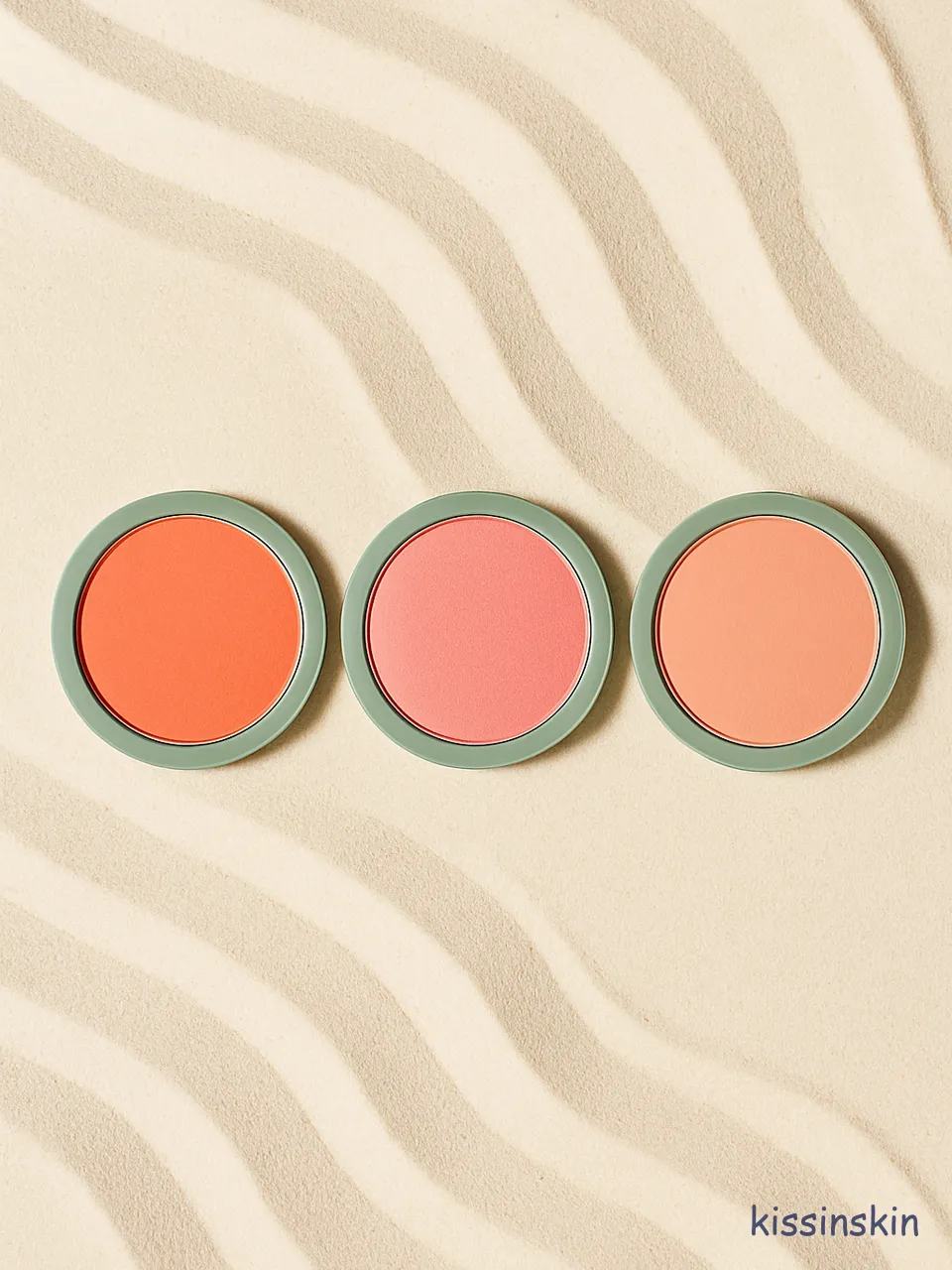
Blush draping is a signature technique of 1970s makeup artist Way Bandy. The method involves blending blush in a gradient from the top of the cheekbones out toward the temples and the outer corners of the eyes, simultaneously enhancing facial contours and adding color. Fifty years later, it has become a global trend again thanks to social media.
The key lies in color selection and gradient technique. Choose colors based on your personal undertone: (1) Spring warm — coral pink, (2) Summer cool — baby pink or lilac, (3) Autumn warm — terracotta or bronze, (4) Winter cool — berry or plum. For the gradient, apply the most intense color at the highest point of the cheekbone, then blend out toward the temples for a natural finish.
Among Korean brands, Clio Pro Blush, Amuse Duo Blush, and Hera My Blush are top picks for their suitable textures. Globally, NARS "Orgasm" and Charlotte Tilbury "Cheek to Chic" are representative. Price ranges: Korea 25,000–60,000 KRW, global 40–70 USD.
Fail-proof application guide: (1) Use a large powder brush, tap off excess on the back of your hand—overapplication is hard to fix. (2) Start above the cheekbone and sweep in a counterclockwise motion (left cheek) or clockwise (right cheek) for a natural curve. (3) Finish the look with a lip color in the same color family for a unified color block.
Market data shows blush draping is the 1970s trend most boosted by the social media era. According to Pinterest’s 2026 report, searches for "blush draping" rose 145% year-on-year, and Instagram’s #blushdraping hashtag surpassed 2.8 million posts. In the K-beauty market, Clio and Amuse have launched duo and trio blush lines specifically for draping, while Japan’s Canmake and the US’s Glossier are releasing similar products. This movement is part of the mega trend of "color blocking that starts at the cheeks and expands across the face."
For effective everyday application, adapting blush draping to face shape and occasion is key. For round faces, extend the blush diagonally from cheekbone to temple for vertical dimension; for long faces, apply horizontally to balance width. For square faces, use a rounded application to soften angles; for heart-shaped faces, blend downward below the cheekbone for lower-face balance. For interviews or formal settings, use half your usual intensity; for dates or events, full draping is ideal. For photo-heavy occasions, go one shade deeper than usual for better color payoff on camera.